- Meaning
- Hatha Yoga Pradipika Chapters in nutshell
- First Chapter – Asana
- Second Chapter – Shatkarma & Pranayama
- Third Chapter – Mudra & Bandha
- Fourth Chapter – Samadhi
- The Main Teachings
The Hatha Yoga Pradipika is one of the oldest and most important texts of Hatha Yoga. It was written in the 15th century and is still studied in yoga teacher trainings around the world today.
If you want to understand where modern yoga practices come from, this text is one of the key sources. It explains not just postures, but breathwork, energy practices, and the deeper purpose behind yoga.
In this guide, you will learn what the text actually teaches, a clear explanation of its meaning, and why it still matters for anyone practising yoga today.
What Is the Hatha Yoga Pradipika?
The Hatha Yoga Pradipika is a classical yoga text compiled by Swami Swatmarama in the 15th century CE. It is considered one of the three main texts of Hatha Yoga, along with the Gheranda Samhita and the Shiva Samhita.
Many elements of modern yoga can be traced back to this text. This includes asana, pranayama, bandhas, and the idea of prana flowing through nadis. If you have heard these concepts in a yoga class, they come from teachings like this.
The original name of the text was Hathapradipika. Over time, the word “Yoga” was added by scholars and translators, which is why it is now widely known as the Hatha Yoga Pradipika.
Swatmarama was clear about his role. In the opening verses he describes himself as a transmitter, not an inventor, gathering knowledge from the Vedas and from the masters who came before him, including Matsyendranath and Goraknath.
Pradipika Meaning: What Does the Title Tell You?
The word Pradipika comes from a Sanskrit root that means “light” or “to illuminate.” A simple translation is “a lamp” or “that which brings light.”
So, Hatha Yoga Pradipika can be understood as “Light on Hatha Yoga.” It is meant to guide practitioners along a path that can be difficult to follow without proper direction.
There is also a deeper meaning. Pradipika can suggest something that shines on its own. This reflects an important idea in yoga: the potential for growth and awareness already exists within you. Practice helps bring it out.
The word Hatha has more than one meaning. It can mean effort or discipline. It is also often explained as:
- Ha (sun)
- Tha (moon)
This represents two opposite energies in the body that need to be balanced.
Taken together, the title points to a clear idea: a path that uses effort and balance to bring clarity and awareness.
Also Read: What is the meaning of ha and tha in hatha yoga
Who Wrote the Hatha Yoga Pradipika and When?
Swami Swatmarama composed the Hatha Yoga Pradipika around the 15th century CE. He was part of the Nath tradition, a lineage known for working with the body and breath to reach deeper states of awareness.
He followed the teachings of earlier masters, especially Gorakhnath. The text also honours Adinath, a name for Shiva, who is considered the original source of Hatha Yoga in this tradition.
Swatmarama refers to many earlier teachers whose knowledge shaped the text, including Matsyendranath, Goraknath, and others. His role was to organise and present these teachings in a clear and structured way.
Different versions of the text have appeared over time, sometimes with slight variations in name and wording, but they all refer to the same core work.
Hatha Yoga Pradipika Summary: What the Text Actually Covers
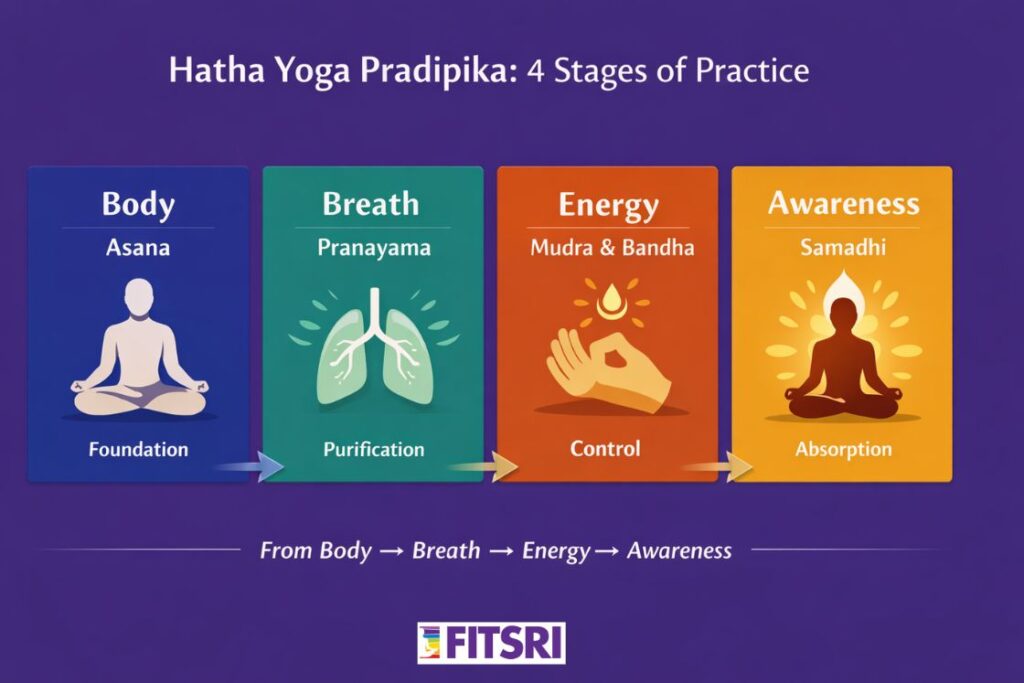
The Hatha Yoga Pradipika contains 389 verses divided into four chapters, known as Upadeshas (teachings). Each chapter builds on the previous one, moving from the physical body to deeper and more subtle aspects of practice.
The structure is intentional. You begin with the body, then move to the breath, then to energy practices, and finally to meditation. Each stage prepares you for the next.
Chapter 1: Asana (67 Verses)
The first chapter begins with an important idea that many modern practitioners overlook. Swatmarama clearly states that the purpose of Hatha Yoga is to prepare for Raja Yoga, which is deep meditation and inner stillness.
This means physical practice is not the final goal. It is the starting point.
The chapter describes 15 classical asanas, with special focus on four key postures for meditation:
It also covers practical guidance such as diet, discipline, and the conditions that support progress in yoga.
One important teaching often mentioned in traditional lineages is that Shiva taught 84 asanas, but only four are considered essential for spiritual growth. This is why the number 84 appears frequently in yoga traditions.
The chapter ends with a clear message. Practice should continue until the mind becomes steady and ready for meditation. Not until physical flexibility is achieved, but until inner stability develops.
Chapter 2: Shatkarma and Pranayama (78 Verses)
Once the body is stable, the focus shifts to purification and breath.
This chapter introduces the Shatkarmas, six cleansing techniques, along with eight types of pranayama based on breath retention.
The six Shatkarmas are:
- Dhauti (cleansing of the digestive tract)
- Basti (cleansing of the large intestine)
- Neti (nasal cleansing)
- Trataka (focused gazing)
- Nauli (abdominal churning)
- Kapalbhati (cleansing breath technique)
These practices are not just physical cleansing methods. Their purpose is to remove blockages so that prana can flow freely through the nadis, or energy channels.
The chapter then explains eight pranayama techniques:
A key point is the sequence. Breath practices should only be done after the body and energy channels are prepared. This order is essential for safe and effective practice.
Chapter 3: Mudras and Bandhas (130 Verses)
This is the longest and most technical chapter of the text.
It explains mudras and bandhas, which are practices used to direct and control the flow of prana in the body. The main goal is the awakening of Kundalini Shakti, the latent energy at the base of the spine.
Some of the key practices include:
Other practices such as Viparita Karani, Vajroli, and Shakti Chalana are also described.
All of these techniques work toward one aim. They guide prana from the side channels, Ida and Pingala, into the central channel, Sushumna. When this happens, the deeper stages of yoga become accessible.
👉 Explore the full Hatha Yoga guide
Chapter 4: Samadhi (114 Verses)
he final chapter focuses on the ultimate goal of the practice, which is Samadhi.
Samadhi is described as a state of deep absorption, where the sense of individual identity begins to dissolve. Swatmarama uses several terms for this state, including Raja Yoga, Laya, Unmani, and Amanaska. Each points to the same experience from a slightly different angle.
This chapter also introduces Nada Yoga, the practice of meditating on inner sound.
Four stages of progress are described:
- Arambha (beginning)
- Ghata (integration)
- Parichaya (deep familiarity)
- Nishpatti (completion)
These stages show how the practice develops over time, from early effort to complete absorption.
Swatmarama also highlights the importance of guidance. He suggests that without proper instruction from a teacher, reaching Samadhi can be very difficult.
The Six Limbs of Hatha Yoga: What Is Shadanga Yoga?
The Hatha Yoga Pradipika presents a system called Shadanga Yoga, which means “six-limbed yoga.” This is different from Patanjali’s Ashtanga Yoga, which is based on eight limbs.
Instead of focusing on a step-by-step philosophical path, Shadanga Yoga is more practical. It focuses on preparing the body, breath, and energy for meditation.
The six limbs of Hatha Yoga are:
- Asana – physical postures
- Shatkarma – purification techniques
- Pranayama – breath control
- Mudra – energy seals
- Bandha – energy locks
- Samadhi – meditative absorption
Each limb supports the next. The aim is to gradually move from physical practice to deeper inner awareness.
One key difference from Patanjali’s system is how the later stages are structured. In the Hatha Yoga Pradipika, practices like Dharana (concentration) and Dhyana (meditation) are not listed separately. They are included within the experience of Samadhi.
Yama and Niyama, which are the ethical foundations in Patanjali’s system, are mentioned in the text but not presented as formal steps. They are treated more as essential qualities that support the practice, rather than stages to complete. conditions rather than formal steps. This reflects the character of the text. It is primarily a technical manual, not a moral philosophy. It assumes you already have the intention to live with integrity.
Core Philosophy: What the Hatha Yoga Pradipika Is Really Teaching
Hatha Yoga Is Preparation, Not the Goal
This idea appears right at the beginning of the text, and it changes how you understand everything that follows.
Swatmarama presents Hatha Yoga as a way to prepare the body and mind for deeper meditation. Without this preparation, most people cannot sustain stillness or focus for long. The body becomes a limitation instead of support.
Hatha Yoga is his solution to that problem.
If your practice is focused only on physical postures, this teaching is worth reflecting on. In this tradition, asana is not the end goal. It is the foundation for deeper inner work.
Balancing Ida and Pingala to Open Sushumna
This is one of the central teachings of the text.
According to the Hatha Yoga Pradipika, the body contains two main energy channels:
- Pingala Nadi on the right side, linked to heat, activity, and outward energy
- Ida Nadi on the left side, linked to coolness, calmness, and inward energy
Most people naturally shift between these two, but rarely experience true balance.
When these energies come into balance, the central channel, Sushumna Nadi, begins to open. This is considered essential for deeper states of meditation and the awakening of Kundalini.
All the main practices in Hatha Yoga, including asana, pranayama, and mudra, are designed to support this process.
The body is not something to overcome in this tradition. It is the instrument you learn to tune. The more precisely you understand it, the further the practice can take you.
Asana Removes Tamas, Not Rajas
The role of asana is not the same in every yoga tradition.
In Patanjali’s Yoga Sutras, asana helps calm Rajas, which is the quality of restlessness and constant activity.
In the Hatha Yoga Pradipika, the focus is different. Here, asana is used to reduce Tamas, which is heaviness, dullness, and lack of energy in the body and mind.
This is why many Hatha Yoga practices are more active and energising. The aim is to remove inertia and prepare the system for more subtle practices.
The postures may look similar across traditions, but the intention behind them can be very different. That intention shapes the outcome of the practice.
The Gheranda Samhita’s Seven-Step Path: How It Relates to HYP
YYou may have come across a seven-stage path in Hatha Yoga that includes purification, strength, steadiness, calmness, lightness, right perception, and isolation.
This system is called Sapta Sadhanama. It is often linked to Hatha Yoga in general, but it does not come from the Hatha Yoga Pradipika.
It comes from another classical text, the Gheranda Samhita (GS 1.9).
The Gheranda Samhita is one of the three main Hatha Yoga texts, written slightly later than the Hatha Yoga Pradipika, most likely in the 17th century. It presents a seven-limbed system, where each stage represents a specific level of development.
The Hatha Yoga Pradipika covers many of the same ideas, but it organises them differently across its four chapters.
This distinction is important. If you are teaching or writing about Hatha Yoga, mixing these two systems can lead to confusion. They are closely related, but they are not the same text or framework.
What Destroys a Yoga Practice: The Six Causes of Failure
The Hatha Yoga Pradipika does not only explain what to practice. It also points out what can quietly disrupt your progress.
The text lists six common obstacles:
- Overeating
- Excessive physical effort
- Too much talking
- Unnecessary or extreme practices
- Spending time with undisciplined or distracted people
- Lack of consistency
These are simple, but they are easy to overlook.
Most practitioners will recognise at least a few of these in their own routine. Even after centuries, the challenges of practice remain the same. are exactly the same. That is part of what makes this text feel relevant rather than historical.
Hatha Yoga Pradipika and the Yoga Sutras: How They Fit Together
Many Western students come across Patanjali’s Yoga Sutras first. When they later read the Hatha Yoga Pradipika, it can feel different or even confusing.
The two texts are not in conflict. They simply focus on different aspects of the same tradition and serve different purposes. Here are the key differences:
- Purpose of asana: Patanjali uses asana to subdue Rajas. The HYP uses asana to remove Tamas. Same tool, different application.
- Kundalini: It is the central organizing concept of the HYP and barely mentioned in Patanjali’s Sutras.
- Format: Patanjali’s Sutras are primarily a philosophical framework. The HYP is a hands-on technical manual with specific instructions.
- Number of limbs: Patanjali offers eight. The HYP works with six, folding some of Patanjali’s stages into others.
- The body: For Patanjali, the body is something to eventually transcend. For Swatmarama, the body is the very instrument of liberation.
Think of Patanjali as the map of the territory and the HYP as the instruction manual for the vehicle you are using to travel through it.
Can Ordinary People Practice Hatha Yoga?
One of the most practical teachings in the Hatha Yoga Pradipika is that yoga is not limited to renunciates or monks.
Swatmarama clearly states that a householder, someone with a family and daily responsibilities, can achieve success in Hatha Yoga.
You do not need to leave your life behind to practise deeply.
What is required is:
- Self-discipline
- Consistent practice
- Moderation in food and lifestyle
- Awareness of where your time and energy go
The text also highlights the importance of good company and mental steadiness. These are not optional. They directly affect the quality of your practice.
The Shiva Samhita, another classical Hatha Yoga text, reinforces this idea even more strongly. The belief that serious yoga requires complete renunciation is a misunderstanding of the tradition.
Conclusion
Swatmarama’s core message is simple. The body is not an obstacle to spiritual growth. It is the starting point.
When you learn to work with the body, purify it, and understand the energy moving through it, deeper practices become more accessible than most people expect.
That is what Pradipika really points to. Not just a text that explains yoga, but a path that helps you understand it through your own experience.
Start with one practice. Stay consistent. Pay attention to what changes.
That has always been the instruction.
Frequently Asked Questions
The text has 4 chapters, covering asana, pranayama, mudras, and samadhi.
The main goal is to prepare the body and mind for Raja Yoga (deep meditation and inner stillness).
Yes, but beginners should focus on basic practices and learn advanced techniques under guidance.
The text teaches:
Asana (postures)
Pranayama (breathing)
Shatkarma (cleansing)
Mudra and Bandha (energy practices)
Meditation (Samadhi)
The Yoga Sutras focus on philosophy and mental discipline, while the Hatha Yoga Pradipika focuses on practical techniques using the body and breath.
It was written by Swami Swatmarama, a yogi from the Nath tradition, around the 15th century.